Share
About Alligator
| What is the difference between Alligator and Crocodile, and why should I care? |
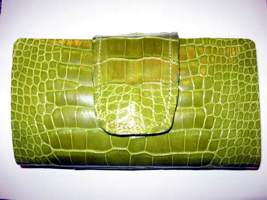 When shopping for fashion products, you may see the term alligator/crocodile used to describe a handbag or wallet. This basically means the seller has no idea what material it is made of, because crocodile and alligator should not be used in the same sentence when describing a product!
Most people confuse crocodiles and alligators, and most Europeans will call a big reptile a "crocodile" even if it's an alligator. And, it turns out there are 3 major categories of reptiles whose skins are used in handbags and that are commonly confused:
When shopping for fashion products, you may see the term alligator/crocodile used to describe a handbag or wallet. This basically means the seller has no idea what material it is made of, because crocodile and alligator should not be used in the same sentence when describing a product!
Most people confuse crocodiles and alligators, and most Europeans will call a big reptile a "crocodile" even if it's an alligator. And, it turns out there are 3 major categories of reptiles whose skins are used in handbags and that are commonly confused:
 "How to identify a Crocodile skin")
 "How to identify a Caiman skin") Crocodile photo left, and Caiman on the right, from the Louisiana Alligator Advisory Council |
|---|---|
| I thought Alligators were an endangered species | They were. A long time ago. Then strict limits were put in place on the number and size of alligators that could be hunted during a specific season of time. And farms were set up to raise the large number of gators that consumers were demanding for various products. Since 1986 the American Alligator has been enjoying a large enough comeback that it is no longer endangered. In fact, there are almost too many of them now! Now it's actually possible to look at a handbag and tell whether the alligator skin was raised on a farm or caught in the wild, just from the size of the bag. That's because farms generally raise alligators to a maximum length of 4 feet, which produces skins about 10 inches wide. Any whole skin that is much wider than 10 inches probably came from an alligator longer than 4 feet, meaning it was probably caught in the wild. Every alligator skin we buy comes with a numbered tag, that allows us to trace it all the way back to its source. We keep track of what products are made with what serial numbered tag, and we only buy from reputable tanneries that work entirely within the law. It's your assurance that your product is entirely legal and does not in any way harm the balance of nature. |
| Why Is Alligator So Expensive? |
Once an alligator hide is harvested, a lot of work needs to be done to turn it into a skin that can be used in a handbag.
The ancient cave dwellers figured out that any animal hide must be treated before it becomes the kind of leather that can be turned into clothing and worn.
This treatment used to be done with bark from trees, with various vegetation, and now is done with chemicals that have the same composition as some of those ancient formulas.
(Trivia: The verb "to tan", as in "tanning" or "tannery" used in connection with tanned leather, comes from the German word "Tanne" or "Tannenbaum", which is the pine tree. Impress your friends!)
After the hide has been cleaned and tanned, it is generally dyed, because most people don't really care for the natural color of alligator skin.
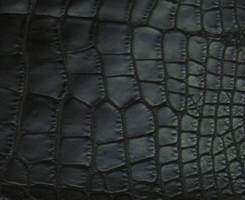
Alligator skin products come in either a glossy, shiny finish, sometimes referred to as "Classic" or "Glazed", or a matte, softer finish sometimes referred to as "Safari" or "Desert".
The glossy finish requires a lot of work to press a protein or albumin into the hide under great pressure, and buff it to a shine.
The cost of an alligator skin that would be suitable for making a small clutch purse, for instance, can be around $400 to $800, depending on the quality of the skin, how many scars and scratches and holes it has.
And that's just for the skin on the outside. If it requires a larger piece, or several pieces, for instance if the interior is also done in alligator, that number can easily double.
Alligator skins have to be worked differently than cowhide leather, too. They don't cut or stitch quite the same way, so different processes and tools are required.
Here are examples of shiny "Glazed" skin on the left, and matte "Desert" skin on the right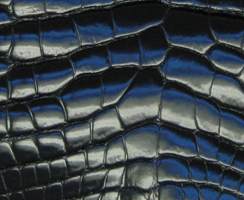
 |
| I bought an alligator purse once, and it was REALLY cheap! |
In addition to Alligator and Crocodile, there is another reptile prevalent in Colombia and other parts of Central and South America called the "Caiman".
There is a lot of confusion surrounding caiman, not the least of which is because it means "alligator" in Spanish! Ugh!
The problem is that Caiman is an entirely different species of crocodilian, and is of a much lower quality and thus cost.
The scales are hard and brittle instead of being supple and flexible.
 "Genuine Alligator???") I bought a purse recently on eBay that was sold as a "vintage alligator purse". On the inside is stamped "Genuine Alligator - Made in Cuba". (See photo at right)
It is so obviously a caiman skin, not an alligator skin, that anybody who knows the difference can tell in 60 seconds that the stamp inside is flat wrong, and possibly fraudulent.
So, how do we tell? Looking at the scales, one can see that each scale is full of spots and there is an abrupt change in scale pattern. That is not characteristic of either alligator or crocodile.
If you want to read more about the differences between these animals, the Louisiana Alligator Advisory Council has a very useful web site full of good information.
Here is another really creepy photo of the front flap of the purse. After you have read on the advisory council web site what a 4-4-2 head bump pattern on the back of the head means, you'll see instantly why this purse is caiman. And why I called it "creepy"!
Beyond the fraudulent claims of shady purveyors of caiman and crodocile skins who take advantage of people who don't know any better, there are also the "Faux" skins that are really just meant to reduce costs.
There's faux fur, and now there's also the cow hide that has been embossed with a reptile scale pattern and called things like "Cocoligator", "Crocodile Print", "Alligator Grain", "Embossed Croc", etc.
These are all generally cowhide leather that has been made to look like reptile scales. Often you can tell these by the consistency of the scale patterns as they repeat themselves down the product.
Or you can tell by the smell of vinyl that it's not even cowhide, much less alligator. But the main clue is that the purse is $19.95 at Wal-Mart and tries to look like alligator.
There is just no way to make an alligator purse for anything less than a few hundred dollars, even if the skin is a low grade full of scratches and holes.
I don't have a problem with making products out of non-Alligator, as long as the buyer understands what s/he is getting.
I bought a purse recently on eBay that was sold as a "vintage alligator purse". On the inside is stamped "Genuine Alligator - Made in Cuba". (See photo at right)
It is so obviously a caiman skin, not an alligator skin, that anybody who knows the difference can tell in 60 seconds that the stamp inside is flat wrong, and possibly fraudulent.
So, how do we tell? Looking at the scales, one can see that each scale is full of spots and there is an abrupt change in scale pattern. That is not characteristic of either alligator or crocodile.
If you want to read more about the differences between these animals, the Louisiana Alligator Advisory Council has a very useful web site full of good information.
Here is another really creepy photo of the front flap of the purse. After you have read on the advisory council web site what a 4-4-2 head bump pattern on the back of the head means, you'll see instantly why this purse is caiman. And why I called it "creepy"!
Beyond the fraudulent claims of shady purveyors of caiman and crodocile skins who take advantage of people who don't know any better, there are also the "Faux" skins that are really just meant to reduce costs.
There's faux fur, and now there's also the cow hide that has been embossed with a reptile scale pattern and called things like "Cocoligator", "Crocodile Print", "Alligator Grain", "Embossed Croc", etc.
These are all generally cowhide leather that has been made to look like reptile scales. Often you can tell these by the consistency of the scale patterns as they repeat themselves down the product.
Or you can tell by the smell of vinyl that it's not even cowhide, much less alligator. But the main clue is that the purse is $19.95 at Wal-Mart and tries to look like alligator.
There is just no way to make an alligator purse for anything less than a few hundred dollars, even if the skin is a low grade full of scratches and holes.
I don't have a problem with making products out of non-Alligator, as long as the buyer understands what s/he is getting.
|
| POP QUIZ |
OK, you've read all that, so tell me what is this cosmetic bag made of?)
|

)
)